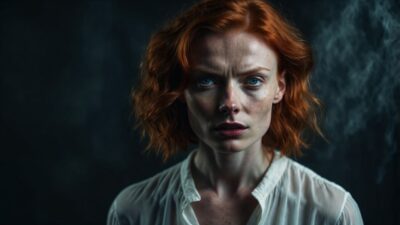
After embracing AI as my brainstorming partner, I quickly realized a fundamental truth: the quality of the output is directly proportional to the quality of the input. Simply asking for “a cool logo” won’t get you very far. Learning to communicate with generative AI is like learning a new language—a language of creative direction. And for a designer, a well-crafted prompt is at least 50% of the work.
1. Principle 1: Specify the Medium
The first and most crucial step is to tell the AI what it’s making. Don’t just describe the subject; define the medium and format. This single instruction grounds the AI’s creativity in a specific context and dramatically improves the result.
Instead of: “A portrait of a woman.” Try:
- “An oil painting portrait of a woman…”
- “A 35mm film photograph of a woman…”
- “A detailed charcoal sketch of a woman…”
- “A minimalist vector illustration of a woman…”
2. Principle 2: Use the Language of Art Direction
You’re a designer—use your vocabulary! AI models have been trained on millions of images tagged with technical and artistic terms. Use them to your advantage to control the composition, lighting, and mood.
Think like a photographer or a film director:
- Lighting: “dramatic lighting,” “soft ambient light,” “golden hour,” “volumetric lighting,” “cinematic lighting.”
- Composition & Shot: “wide-angle shot,” “macro shot,” “low-angle shot,” “symmetrical,” “depth of field.”
- Color: “vibrant color palette,” “monochromatic,” “pastel colors,” “muted tones.”
3. Principle 3: Invoke Artists and Movements
This is the ultimate shortcut to a specific aesthetic. By referencing a famous artist, an art movement, or a distinct style, you give the AI a massive library of visual information to draw from.
Instead of: “A surreal landscape.” Try:
- “A surreal landscape in the style of Salvador Dalí.”
- “A city street designed in the Bauhaus architectural style.”
- “An Art Deco movie poster for a sci-fi film.”
- “An impressionist painting of a lily pond.”
4. Examples: Bad Prompts vs. Good Prompts
Let’s see it in action.
Bad Prompt: “A knight fighting a dragon.” This is too vague. The AI has to make too many assumptions.
Good Prompt: “An epic, dynamic digital painting of a knight in polished silver armor fighting a fearsome red dragon. Dramatic lighting, sparks and embers flying, wide-angle shot, in the style of Frank Frazetta.” This prompt defines the medium, the action, the lighting, the composition, and the artistic style, leading to a much more specific and powerful image.
Bad Prompt: “A car on a road.” Simple, boring, and uninspired.
Good Prompt: “A cinematic 35mm photograph of a classic red 1960s convertible driving on a coastal highway at sunset. Golden hour lighting, lens flare, soft focus on the ocean background, sense of freedom and adventure.” This prompt tells a story and sets a specific mood, giving the AI all the cues it needs.
Mastering the art of the prompt isn’t a technical chore; it’s a creative skill. It’s how we translate the vision in our heads into a language the AI can understand, turning a simple tool into a true creative partner.